Walk into any kitchen, and you will likely see a scarred plastic board or a heavy, stained wooden block. For decades, these have been the standard. But they harbor a dirty secret. Every time your knife slices through a plastic board, it doesn’t just cut food; it cuts the board itself, releasing thousands of microscopic plastic particles into your meal. Over a year, this can amount to eating a credit card’s worth of plastic.
Wooden boards, while natural, are sponges. They absorb meat juices, bacteria (like E. coli and Salmonella), and odors. Unless you are oiling and sanitizing them religiously, they become a breeding ground for germs.
Marketed as the “Tesla of Cutting Boards,” Tivano utilizes the power of Medical-Grade Titanium to solve the hygiene and durability crisis in one fell swoop. It promises a surface that is anti-bacterial, impossible to scar, and easy to clean. But is a metal board really the answer? Will it ruin your expensive knives? Is it worth the premium price tag?
What Is Tivano Cutting Board?
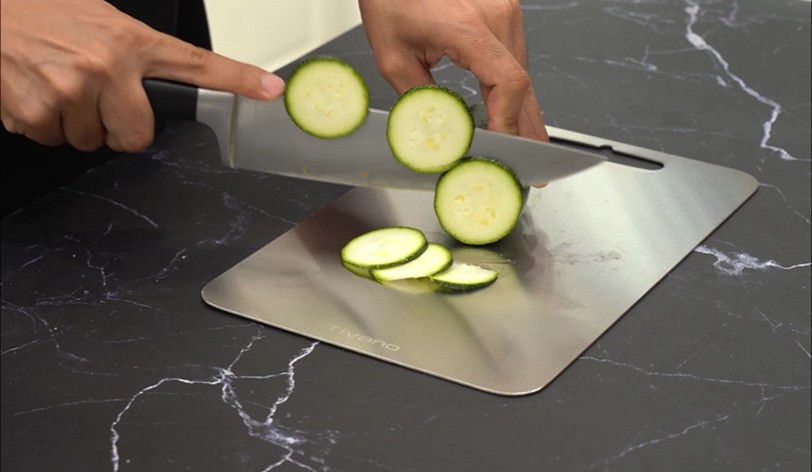
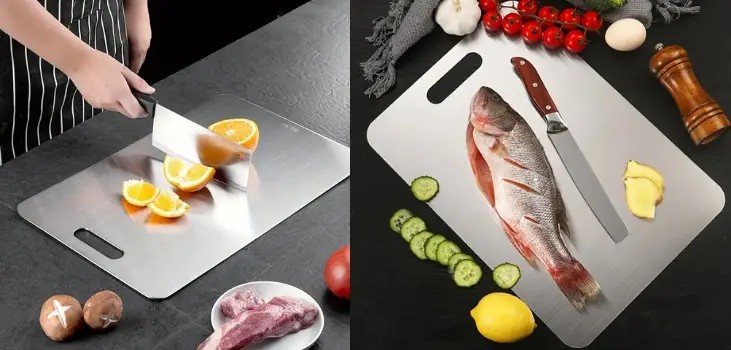
Tivano Cutting Board is a next‑generation kitchen board built around a titanium‑coated surface branded as TitaniumShield™, designed to be non‑porous, antibacterial, and highly scratch‑resistant. Unlike wood, which absorbs juices and harbors bacteria, or plastic, which scratches, stains, and can shed microplastics into food, Tivano’s titanium layer forms a sealed barrier that keeps liquids and microbes from penetrating.
The board is positioned as suitable for both home cooks and professional chefs, with marketing that emphasizes food safety, easy cleaning, and knife‑friendly hardness that won’t dull blades the way glass or ceramic surfaces do. Independent reviews describe it as a premium, niche product compared with ordinary boards, but one that could replace multiple cheaper boards over time because of its longevity.
How Tivano Cutting Board Built?
TitaniumShield™ / titanium surface
The standout feature of Tivano is its titanium‑based surface—either pure titanium or a titanium coating, depending on the specific SKU and site—that creates a smooth, non‑porous cutting area.
Key characteristics include:
- Non‑porous and stain‑resistant: Meat juices, colored vegetables, and sauces sit on top of the surface instead of soaking in, reducing lingering odors and stains.
- Antibacterial behavior: Titanium inherently resists corrosion and does not support microbial growth; the absence of deep grooves and pores also removes hiding spots for bacteria and mold.
- Scratch resistance without being glass‑hard: The surface is designed to be harder than wood or plastic but engineered with microscopic texturing to avoid acting like glass or stone that rapidly dulls knives.
Some retailers and competing titanium boards explain that titanium is softer than many knife steels, so it preserves edges better than glass or ceramic while still resisting cuts and grooves dramatically better than plastic.
Multi‑layer 4‑layer design and core
Tivano’s recent official pages describe a 4‑layer design that combines the titanium surface with a stable inner structure.
Typical elements include:
- TitaniumShield™ top layer: Food‑contact surface that is non‑porous, antibacterial, and knife‑friendly.
- Reinforced core: Engineered to be lightweight yet warp‑resistant, so the board stays perfectly flat even with hot items or heavy chopping.
- Non‑slip silicone corners or feet: Provide grip on countertops without interrupting the hygienic titanium surface area.
- Finished underside: May be double‑sided on some variants, allowing separate sides for raw meats vs produce to minimize cross‑contamination.
This layered construction is designed to offer metal‑like durability with a more manageable weight than a solid metal slab.
Key Features and Benefits:
1. Superior hygiene and food safety
Tivano is marketed first and foremost as a hygienic cutting board.
- Non‑porous surface: Blocks blood, juices, and moisture from seeping into the board, unlike wood and bamboo.
- Bacteria‑ and mold‑resistant: Fewer grooves and pores mean fewer hiding spots for microbes; press releases frame it as actively resisting bacteria, mold, and fungus.
- Zero microplastics: Unlike plastic boards, the titanium layer does not shed microscopic fragments into food over time.
This makes Tivano particularly appealing for people concerned about foodborne illness, raw meat contamination, or plastic exposure in daily cooking.
2. Knife‑friendly titanium surface
Although titanium sounds extremely hard, the surface texture and material pairing are tuned to be kind to knives.
- Microscopic surface texture: An invisible pattern is etched into the titanium shield to provide just enough friction for control without chipping or rolling knife edges.
- Softer than ceramic/glass: Like other titanium boards, Tivano aims for a hardness sweet spot—durable enough to resist deep cuts, yet softer than knife steel and hard glass so it doesn’t wreck edges.
- Flat, stable platform: The board’s lack of warping and non‑slip corners contributes to more precise cuts and safer knife handling.
For home cooks frustrated by boards that dull premium knives quickly, this knife‑friendly focus is a major selling point.
3. Durability and warp resistance
Tivano is pitched as a “buy it once” cutting board thanks to titanium’s strength and the reinforced core.
- Highly scratch‑resistant: It is “virtually immune” to the knife marks and deep grooves that quickly degrade wood and plastic boards.
- Warp‑resistant and heat‑tolerant: The board resists warping or cracking when exposed to hot pans or frequent washing, unlike many bamboo/plastic boards.
- Long service life: Because the surface doesn’t degrade or gouge easily, you avoid the cycle of replacing cheap boards every year or two.
Press coverage highlights this durability as both an environmental and cost benefit over time.
4. Easy cleaning & dishwasher safe
Tivano aims to be as low‑maintenance as possible.
- No oiling or conditioning: Unlike wood, you don’t need to oil or baby the surface to keep it from drying or cracking.
- Rinse or dishwasher: Food doesn’t cling tightly to the titanium layer, so most messes rinse off; the board is also marketed as top‑rack dishwasher safe.
- No lingering odors: The non‑absorptive surface doesn’t hold onto garlic, onion, or raw fish smells.
This simplicity is attractive for busy households where boards see heavy daily use.
Tivano vs Traditional Cutting Boards
| Feature / Concern | Tivano Cutting Board (Titanium) | Wood/Bamboo Board | Plastic Board |
|---|---|---|---|
| Surface porosity | Non‑porous, blocks liquids and microbes. | Porous; absorbs juices and odors. | Initially smooth, but it becomes porous as it scratches. |
| Bacterial harboring | Minimal grooves; easier to sanitize. | Knife grooves harbor bacteria deep inside. | Scratches trap bacteria and food residue. |
| Microplastic risk | None; the titanium surface is stable. | None, but may splinter if very worn. | Can shed microplastics with repeated knife use. |
| Knife friendliness | Engineered texture; gentle on edges. | Generally kind to knives, but degrades over time. | Softer early on, but it can scar and become uneven. |
| Durability/warp resistance | Highly scratch‑resistant, warp‑resistant, heat‑tolerant. | Can warp, crack, or split; sensitive to moisture. | Can warp or melt; stains and odors accumulate. |
| Cleaning & care | Dishwasher‑safe; no oiling or special care. | Hand‑wash; needs oiling/conditioning. | Dishwasher‑safe but degrades faster. |
| Upfront cost | High (premium product). | Low‑to‑mid, depending on quality. | Low; often replaced more frequently. |
Deep Dive: The “Knife Dulling” Myth
This is the #1 objection from cooking enthusiasts. “Won’t metal on metal ruin my Shun or Wusthof knives?”
The answer lies in the Mohs Scale of Hardness.
-
Hardened Steel (Knife): Typically 7-8 on the Mohs scale (depending on Rockwell hardness).
-
Titanium: Generally around 6 on the Mohs scale.
-
Granite/Glass: 6-7+ (Often harder or equal to steel).
Because pure Titanium is softer than high-carbon steel, the board will theoretically “give” slightly under the blade rather than rolling the edge of the knife immediately.
-
Real World Expectation: It is harder than wood. You may need to hone your knife slightly more often than if you used a soft end-grain walnut board, but it is not catastrophic like glass. The trade-off is superior hygiene.