In an era where the fluctuating cost of gasoline and diesel continues to strain household budgets, motorists are constantly on the lookout for innovative ways to cut down their transportation expenses. Daily commuting, severe traffic congestion, long-distance journeys, and frequent trips to the gas station can significantly increase the overall cost of owning a car. As a result, many vehicle owners are exploring aftermarket accessories that promise better mileage and a more economical driving experienc.
Enter the Eco Fuel Saver, a compact, heavily marketed electronic gadget that promises to revolutionize your vehicle’s fuel consumption [cite: 1.1.3]. By plugging directly into a car’s onboard diagnostic (OBD2) port, the Eco OBD2 Fuel Saver claims to optimize engine performance, reduce harmful emissions, and deliver substantial savings at the pump. But in a market historically flooded with automotive gimmicks and “snake oil” products, does this tiny green chip actually work?
In this comprehensive Eco Fuel Saver Review 2026, we will investigate the science behind the device, evaluate real-world Eco Fuel Reviews And Complaints, explore the purported Eco Fuel Benefits, and determine whether this gadget is a legitimate investment or a clever marketing illusion.

What is the Eco Fuel Saver Reviews?
The Eco Fuel Saver (often branded interchangeably as the Eco OBD2 Fuel Saver or Effuel) is marketed as a convenient, plug-and-play automotive accessory designed for vehicle owners interested in fuel efficiency.
Physically, it is a small, lightweight processor housed in a brightly colored (usually green) plastic casing. The device features a standardized 16-pin connector designed to plug directly into your vehicle’s OBD2 socket—a diagnostic port that has been mandatory in all cars sold in the United States since 1996, and in Europe since 2001.
Unlike traditional engine tuning, which requires expensive mechanical modifications, complex software flashes, or specialized mechanic labor, the Eco Fuel For Car chip is advertised as an accessible solution for the everyday driver. The manufacturer claims that it is a smart processor that helps fight climate change by regulating fuel intake and reducing the release of harmful gases into the atmosphere.
The Core Promise
The primary selling point of the Eco OBD Fuel Saver is its bold claim of enhancing your vehicle’s fuel efficiency by anywhere from 15% to 35% . By allegedly mapping your driving habits and engine parameters, the device promises to pay for itself within weeks, offering a one-time investment with no recurring subscriptions or hidden upgrade fees.
How Does the Eco OBD2 Fuel Saver Claim to Work?
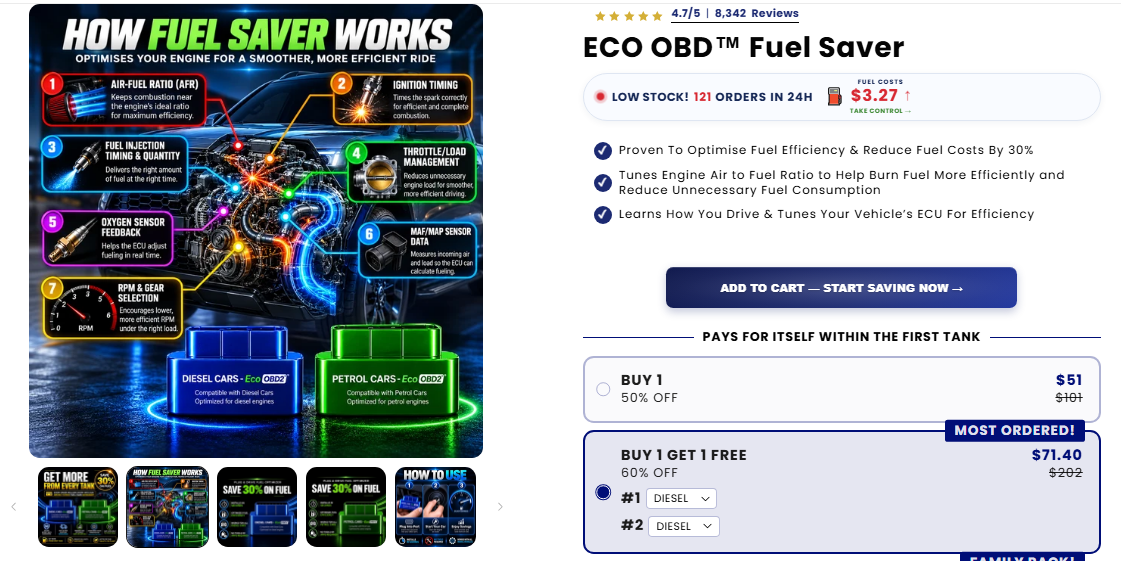
To understand the claims made by the manufacturer, it is essential to look at the relationship between your car’s engine and its computer. Modern vehicles are controlled by an Electronic Control Unit (ECU). The ECU monitors various sensors (oxygen, mass airflow, throttle position, etc.) to optimize the air-to-fuel ratio, ignition timing, and turbo boost pressure for efficient combustion.
According to the official marketing materials, the Eco OBD2 Fuel Saver functions as a “drive and plug” economy chip tuning box. Here is the theoretical process the company describes:
-
Data Collection: Once plugged in, the processor allegedly spends the first 150 miles (or 200 kilometers) collecting data from the vehicle’s ECU to learn your specific driving habits.
-
ECU Remapping: After analyzing this data, the chip claims to actively adjust the vehicle’s parameters—altering fuel injection timing, adjusting boost pressure, and refining the fuel quantity sent to the combustion chamber.
-
Efficiency Optimization: By controlling the fuel intake, the vehicle is supposedly prevented from burning excess fuel, thereby saving cash at the gasoline pump and conserving pollution.
The appeal of this system is undeniable. The idea that a simple electronic handshake between a plug-in chip and your car’s brain could unlock hidden efficiency is a highly attractive proposition for budget-conscious drivers.
Key Eco Fuel Benefits for Your Vehicle
For consumers looking to Eco Fuel Saver Buy, the promotional materials list several distinct advantages. Here is a breakdown of the primary Eco Fuel Benefits as claimed by the product’s distributors:
1. Significant Fuel Cost Reduction
The most prominent benefit is the potential to increase vehicle fuel efficiency by 15% to 35% [cite: 1.1.1]. If true, a driver spending $200 a month on gasoline could theoretically save between $30 and $70 monthly.
2. Environmental Protection
The device claims to regulate fuel intake so that the engine releases fewer harmful gases and substances into the atmosphere, contributing to the fight against climate change and pollution [cite: 1.1.1].
3. Compact and Portable Design
The product category emphasizes a small form factor that fits conveniently under the dashboard [cite: 1.1.3]. This design is highly attractive to drivers who prefer automotive accessories that do not require extensive space or permanent mechanical alterations to their engine bays [cite: 1.1.3].
4. Simple Self-Installation
The Eco OBD2 Fuel Saver requires no professional installation. Its plug-in connectivity allows users to bypass mechanics entirely, simplifying the process for drivers with zero technical expertise.
5. Cost-Effective, One-Time Investment
Compared to professional ECU tuning (which can cost hundreds or thousands of dollars), the chip is marketed as a highly affordable alternative with no subscription fees or mandatory software upgrades [cite: 1.1.1].
Step-by-Step Installation Guide
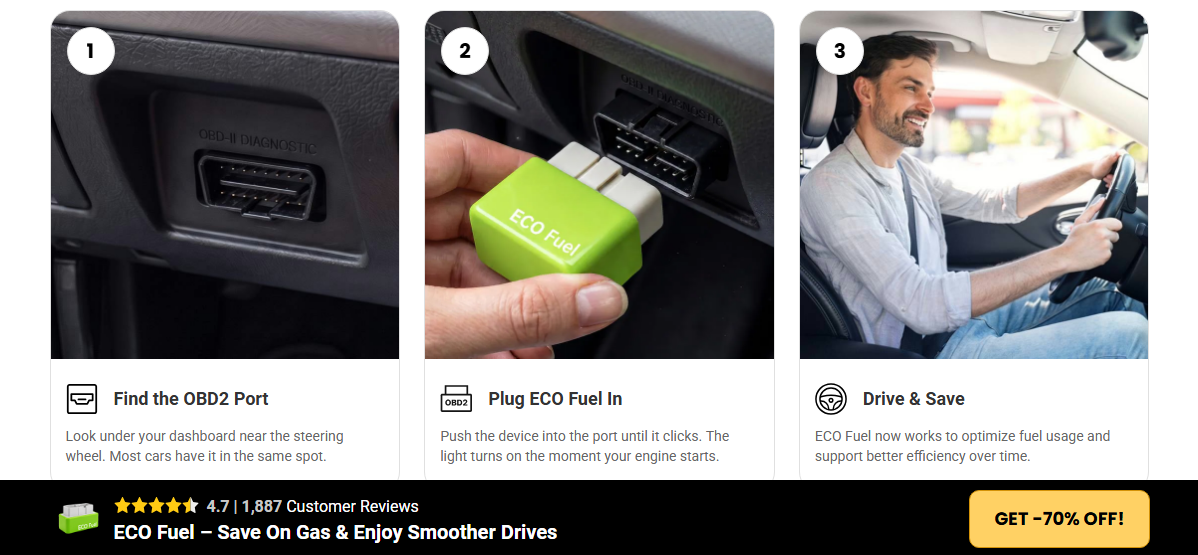
One of the main reasons the Eco Fuel Saver is so popular is its foolproof installation process. According to the manufacturer, setting up the device takes less than five minutes. Here are the required steps to use the chip:
The Controversy: Eco Fuel Reviews And Complaints
While the marketing promises sound phenomenal, the Eco Fuel Reviews And Complaints landscape tells a wildly different story. Any commercial investigation into this device must address the severe skepticism and outright scam allegations leveled by automotive experts.
The Expert Verdict: Is it a Scam?
Many independent electronics experts and mechanics have taken these devices apart to see what makes them tick. Most notably, the popular electronics engineering channel EEVblog analyzed an Eco OBD2 Fuel Saver and exposed it as a “complete scam”.
According to their teardown, while the device is supposed to talk to the car’s ECU via the CAN bus on the OBD2 connector, the internal circuitry often lacks the necessary hardware to communicate with the vehicle at all. In many instances, the circuit board inside the green plastic shell is nothing more than a basic timer hooked up to a series of blinking LED lights. The device draws a tiny amount of power from the OBD2 port to flash the lights, giving the illusion that data processing is occurring, when in reality, it is completely passive.

Why Do Some Users Report Success?
If the device doesn’t actively change engine parameters, why do some Eco Fuel Saver Reviews online feature users claiming their mileage improved?
Automotive experts attribute this to the Placebo Effect and subconscious changes in driver behavior. When a driver installs a device explicitly meant to save fuel, they subconsciously begin to drive more economically. They may accelerate more gradually, anticipate traffic to reduce unnecessary braking, avoid excessive idling, and drive closer to the speed limit. These behavioral changes—not the chip—are what actually lead to a reduction in fuel consumption.
Furthermore, simply plugging a generic accessory into an OBD2 socket does not automatically modify engine settings. Claims about improved mileage should always be evaluated using reliable performance evidence rather than assumptions.
Common Complaints
-
Zero Measurable Difference: The vast majority of verified buyers complain that after driving the required 150 miles, their miles-per-gallon (MPG) remained entirely unchanged.
-
Compatibility Issues: Some users report the device is not compatible with all car models, despite claims of universal fitment.
-
Limited Inventory Claims: The marketing often uses high-pressure tactics, claiming that the business is “running low on inventory” and is only made in a limited variety. This is a common tactic used in dropshipping to create artificial scarcity.
Eco Fuel Saver Price and Where to Buy?
For those still curious to test the device for themselves, finding the Eco Fuel Saver Price reveals that it is a relatively low-risk financial investment.
On various automotive dropshipping and retail sites, the Eco Fuel Saver is typically priced around $19.99. Some retailers offer bulk discounts or sliding shipping scales. For instance, standard delivery (3-7 working days) might cost an additional $12 for orders under $89.99, while orders over $180 often qualify for free shipping
Finding the Eco Fuel Saver Official Website
Because these generic OBD2 chips are manufactured in massive quantities overseas, they are rebranded under dozens of different names (EcoOBD2, Effuel, NitroOBD2). If you decide to make a purchase, it is highly recommended to seek out the Eco Fuel Saver Official Website or a reputable distributor that offers a clear return policy.
Look for sites that offer secure payment options (such as PayPal or direct credit card processing) and transparent refund policies. For example, some sellers will accept order cancellations before the product is shipped and offer full refunds. Always consult an expert advisor or your vehicle’s manufacturer before making any such purchase, as unauthorized devices are used at your own risk.
Genuine Alternatives to the Eco OBD Fuel Saver
If you want to achieve the 15% to 30% fuel savings promised by the Eco Fuel For Car device, there are proven, mechanical, and behavioral methods to do so without relying on a plug-in chip:
-
Professional ECU Remapping: A legitimate dyno-tune by a professional mechanic can actually alter your ECU to lean out fuel mixtures, though this often prioritizes power over economy and can void warranties.
-
Proper Tire Inflation: Keeping your tires inflated to the manufacturer’s recommended PSI can improve gas mileage by up to 3%.
-
Weight Reduction: Remove unnecessary cargo from your trunk; extra weight demands more engine effort and fuel.
-
Routine Maintenance: Follow the recommended service schedule, use the correct engine oil, and replace dirty engine air filters.
-
Eco-Driving Habits: The most effective “chip” is your own foot. Accelerate gradually, maintain steady speeds, and avoid excessive idling when it is safe to switch off the engine.
Final Verdict: Is the Eco Fuel Saver Review 2026 Positive or Negative?
The commercial investigation into the Eco OBD yields a polarizing conclusion.
On one hand, the Eco Fuel Saver is an incredibly affordable, easy-to-install accessory. The marketing is highly compelling, tapping into the very real pain point of soaring fuel prices. For a mere $20, many drivers feel it is worth the gamble just to see if the Eco Fuel Benefits hold true.
On the other hand, empirical evidence and deep-dive technical reviews from electrical engineers strongly suggest that the device is a placebo. The flashing lights provide a comforting illusion of high-tech optimization, but the underlying hardware lacks the capability to interface with your car’s complex fuel-injection mapping.
If you are looking to genuinely save fuel in 2026, your money is far better spent on a fresh set of spark plugs, a clean air filter, or simply practicing mindful, economical driving habits. While the Eco Fuel For Car chip may serve as a psychological reminder to drive with a lighter foot, the chip itself is unlikely to be the technological miracle it claims to be.
Frequently Asked Questions (FAQs)
Does the Eco OBD2 Fuel Saver void my car’s warranty?
No. Because the device (in most tested cases) does not actually write data to your ECU or make permanent mechanical changes, it will not void your warranty. It can simply be unplugged at any time, leaving no digital footprint.
Is it safe to leave plugged in?
Generally, yes. It draws a very minimal amount of power to flash its LED lights. However, if left in a parked car for several months without the engine running, any OBD2 device can eventually drain the vehicle’s battery.
Will the Eco Fuel Saver work on diesel trucks?
The standard green EcoOBD2 is marketed for Benzine/Gasoline cars. Distributors usually sell a separate color (often blue or red) specifically marketed for Diesel vehicles, though the internal mechanisms are subjected to the same scrutiny and skepticism by experts.
How do I track if it’s working?
To accurately measure any changes, compare fuel consumption across multiple full tank refills rather than relying on one short journey or your car’s digital dashboard estimation.